
Smoke gets in my eyes, Sleepy.
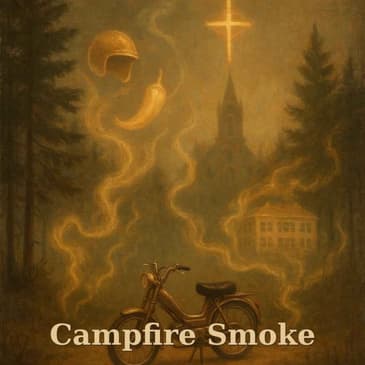
Tonight, we wander through the fog—the good kind, the dreamy kind. The kind where thoughts are like lazy ghosts around a campfire, dodging the marshmallows and heading straight for your face. I talk about mopeds, naturally. And being an idiot. Also naturally. Youth, spicy food, graves under church carpets, and the weight of choosing love—whatever that means.
There’s a subtle kind of crying happening, but don’t worry. It’s the sort that doesn’t need comfort. It just is. Like you. Like me. Like a rotating crucifix above the altar (don’t ask).
Let’s begin. It is what it is. What happens, happens. And right now, there’s nothing we can do about it.
Sleep Tight!
More about Henrik, click here: https://linktr.ee/Henrikstahl
Hosted on Acast. See acast.com/privacy for more information.
[00:00:00] Hi Sleepy, just a very quick note before we start today's episode. Do you want to listen to this podcast without the ads? Then you absolutely can. Just subscribe to Fall Asleep with Henrik Plus and to do so you can just click the link in the podcast description and it'll be fixed. See you there.
[00:00:23] Hi and welcome to Fall Asleep with Henrik. I'm Henrik and you're sleepy and it is what it is, what happens happens. And right now there is nothing we can do. So let's begin. Hi Sleepy, I'm back.
[00:00:51] As usual, this is not a podcast that you need to pay attention to. You can just listen to whatever I say. I haven't prepared anything. I am not here to entertain you and I'm not here to bore you. I'm not here to do anything really except I'm here to do something. If that sounds confusing then that's the purpose.
[00:01:22] My name is Henrik. I am a Swedish actor and writer and podcaster and I make my living from this Swedish version of this podcast called Somna med Henrik.
[00:01:36] And yeah, this is kind of a side hustle. I have big dreams for the English version of my podcast but I'm not there yet and I kind of like it.
[00:01:58] It's a very imaginative era when your dream is not yet fulfilled. When you haven't ruined anything yet. When you haven't taken any wrong turns. When you haven't failed.
[00:02:21] I always enjoy the startup of stuff because then you can't fail because you haven't built anything yet.
[00:02:31] So I'm in my studio, Adventure Wolf, deep in the Swedish suburb forests. Around me is a nature reserve. Miles and miles and miles of forest and you can't touch it.
[00:02:53] It's a combination of privately owned, very old land and nature reserve. So behind me are the villas and the houses and in front of me are the forest and the lakes and the mountains.
[00:03:14] And although I am in the capital of Stockholm, we have so much forest and so much water. And that is why I really love to live here. Although I, well, to be honest, I would prefer to live up north right now. I would love to live in the north of Sweden at this very moment very much.
[00:03:45] But I'm, I'm here. I got my family here. I got my roots here. I got my life here. And it was my dream for a long, long time to get here.
[00:04:02] I'm brought up. I grew up in a little small village outside a small town in Dala Kalia, Sweden. It's like, it's not the middle of Sweden. It's, if you look at Sweden, it's a very tall country. It's long and it's narrow in a way.
[00:04:23] So we have a lot of land on a vertical line on the world map, but not so much on a diagonal line. So there's a lot of north in Sweden. And Dala Kalia is like 200 kilometers from Stockholm, if you go north.
[00:04:49] And so whenever I talk to stockholmers, I mean, real, real sour bread, sourdough bread fed stockholmers. Whenever I talk to them about my origin, they say I'm from the north of Sweden, but that's not true really.
[00:05:16] I mean, I'm north compared to Stockholm, but it's like, it's not very far up north. So, but Dala Kalia is a very traditionally, quote unquote, Swedish part of Sweden. You know, all these images you get if you come from another country and you go to Sweden, so much of it is Dala Kalia inspired.
[00:05:43] Like small cottages with red cottages with white sides. What do you call it? The, the, oh God, what do you call the borders of the house? You know, it's like in Sweden, we call it Knutar, but it's not like knots because Knutar is also a name for knots.
[00:06:06] So if you picture a red Swedish house, a red painted Swedish house with this traditional Swedish red color that originally came from, from, it's, it comes from Fallon where I'm from, the city, the nearest city.
[00:06:30] And I think that the color originally, yeah, it was made from the copper in the mine, the copper mine there hundreds of years ago. And I don't know how they make it today. I guess maybe they still use, I don't, I don't know anything. You should never listen to me as a factual based podcast.
[00:07:00] Anyway, when I lived there in my high school years and later on, I was, I couldn't wait to get away. I couldn't wait to get to Stockholm because Stockholm is and or was maybe in my mind, the cultural headquarters of Stockholm. Every film, every play, everything as far as I was concerned was, took place in Stockholm.
[00:07:29] So I applied for several acting schools in Stockholm and Gothenburg and Malmö. These are the three biggest cities in Sweden. Well, not biggest, but most dense with, you know, people.
[00:07:51] I think the biggest city is, well, it's, I mean, geographically speaking, of course, it must be Stockholm. I don't know. Feel free to correct me in any medium you see fit. So I was longing to get here for so many years.
[00:08:16] And then I, I was admitted to the acting school of Gothenburg. So I didn't get here immediately. But right after I finished that school, I moved here. So I've been living in this town and its surroundings for since 1998. 1998.
[00:08:45] I don't know how many years that is. But that is, well, I could figure it out. But I think it's so boring to count because I need to, I need to count on my fingers because I'm really bad at doing math in my head. And this is the, has been the case for my whole life. And I can see the same pattern in my daughter. She really hates to just measure stuff. Math wise.
[00:09:14] She's, she's a very bright girl. I should say. I think so. At least I'm her father. So I guess I'm. Bias. But. Yeah, she's, she's like brilliant. But she can't do math. And neither can I. And she's, I should say, she's better than me.
[00:09:39] In math, but, but any, yeah, bad anyways. So I don't know. I've been living here since 1998. I guess it's some, it's like 27 years, maybe. I don't know. And right now I would so like to live somewhere else. Preferably up north.
[00:10:09] I have done a lot of work, acting work in the north of Sweden. But I haven't really lived there. Well, I lived in a city called Umeå from time to time in work. I've been working at this theater group up there for, yeah, a lot of projects. But, and I really loved it there.
[00:10:38] So that's the closest thing I've went to ever live up north. But I would love to live, like, even further up north. Right now, I think that would elevate my heart in a lot of ways. But then again, you can't just go around changing your life.
[00:11:05] You know, it's a myth that you can't change your life. No, it's not. I'm sorry, sleepy. So this is proof of that you don't need to take anything I say really seriously. I'm just speaking, you know. I guess this will be a very foggy episode because I feel foggy in my head. Can you say foggy, sleepy? Can you say foggy about something that is sort of like fog?
[00:11:31] Your mind is clattered with smoke. Your thoughts are not distinct. They are smoke. They are drifting aimlessly through your brain. And just, you know, you can't control it really.
[00:11:54] It's like trying to control if you're at a campfire and you get the smoke from the campfire in your eyes. You can't really avoid it. It happens, you know. And then you have a choice. You can either move and hope that the wind doesn't follow you. Or you can just stand your ground and make the fire, let the fire do whatever it wants, smoke-wise.
[00:12:26] I had this idea ages ago that I was a magnet for smoke from the fire. That whenever I was at a campfire, it's been a while since I've been at a campfire though. But back in the day, I used to do that quite frequently. Every summer, I went to this place in Dala Kalia and I worked with this play.
[00:12:52] And yeah, it was really wildlife in a way, not in a literal sense. It wasn't out in the wilderness. It was in a small village. But the nature of the work and the nature of the people that I worked with was like in the evenings, we sit down around fire and we drink and we talk and we sing and we play music. And it was wonderful. It was really great.
[00:13:23] I love that part of that job. And then I had this theory that I was built up by something that attracted smoke from burning wood. Because wherever I sat, the smoke just immediately flowed into my eyes. And I was like, really? Again? And so I moved and the smoke just followed me around the fire.
[00:13:53] Smoke gets in my eyes, I should say. And at this very moment, actually, it's like smoke gets in my eyes. Because, well, don't get scared now, sleepy. But I'm actually crying at this moment. I don't say this to gain your sympathy or anything because I'm not sad. It's just whenever, sometimes, sometimes, when I sit down and I talk from a place within me, you know?
[00:14:22] This core place that you almost have no words to describe. But I know that I'm around that area in me because I tear up. It's been like this all my life that whenever I sit down and speak about stuff that don't really matter in a literal sense.
[00:14:47] When I speak about stuff that just come up, I tend to go to a place within me where I touch stuff that actually, not in a literal way, but actually quite real, touches me, you know? And the things that I say tend to have everything to do with how I feel and what I'm going through.
[00:15:20] And one of the signs that this is occurring is that I tear up. And it's got nothing to do with sadness. Well, sometimes it has to do with sadness and sometimes it has to do with joy. But I believe that this state goes beyond any particular feeling.
[00:15:45] It's almost like I'm walking on the sandy, muddy bottom of myself, the lake that is me. That's a truly rewarding feeling. Although it takes a toll on you. I tend to be tired when I'm done.
[00:16:11] And I don't know if this is a legit method of reaching stuff that are really beneficial to you. For your psyche, for your self-image, for your relationship to yourself. But it's so nice. I can settle with that. I can settle with nice.
[00:16:35] It's so nice to, without aim, without really knowing where you are going and what you're doing, feel your way through yourself. And by doing this, you tend to feel it's almost like a massage in a way. So it's an emotional process.
[00:17:05] I don't really know how you do it. So I couldn't teach it, you know. Sometimes I really wish that I could make others feel what I feel when I'm in this state. Because it's comforting.
[00:17:26] And it's, I mean, compared to other states where you feel like totally calm and focused and, well, not focused. That's not a word to describe it. Calm and centered. There are other ways to feel this.
[00:17:51] But this method, for me, by far is the most efficient and the most long-lasting, you know. I mean, I've been doing other stuff. Like breathing exercises and drinking heavily. You know, two different things. I would recommend the breathing exercises before the drinking, though.
[00:18:19] So I don't drink anymore because it's, yeah. Drinking is by far the worst. But the cool thing about drinking is that the effect comes like almost immediately. I remember when I was young, you know, I could start crying with happiness whenever I had a drink because I just felt like, I felt in touch with whatever it was going on within me at the time.
[00:18:48] So this, what I'm doing here has the same effect. But the arousament is, yeah, it doesn't show up in the same way. And, I mean, there are no really, there are really no other way of reaching that type of arousament that alcohol did for me. But the side effects were too, you know, it's not worth it in the end. So I quit that.
[00:19:17] But I would love to be able to, you know, really make others, give others the tools that I use to reach this state because it's, I would really recommend it to take a stroll inside yourself every day and doing it like in a real way.
[00:19:44] Because in a way, talking to you, Sleepy, right now forces me to do this. I don't know if I could keep up a routine where I do this without recording myself every day. And I don't know if that even would have the same effect on me. I don't know the listener, aka you, Sleepy.
[00:20:10] You are very much necessary in this process because if this isn't a dialogue in a way, you know, if I don't picture you, then there is no listener, there is no target. And so my words become meaningless, just ramblings. I do that too, though. I speak, I talk to myself like almost throughout the entire day.
[00:20:39] I'm, since I work alone, I'm alone a lot of the time. And I talk to myself like constantly. And I talk to people that I think about. I talk to people like people important to me. I talk to them as well without them knowing it, without them being there.
[00:21:05] Sometimes they're really far away from me in space and time. But I keep talking to them. Actually, I never talk to my grandma. She's dead. She died in 2003. 2003. And I really loved her and we really had a good connection.
[00:21:34] And no, I never talk to her. I talk about her, though, a lot. But I never talk to her. I wonder why. Sometimes I wonder if the love for her, because when she was alive, I took her really, I really took her for granted. The love was real, but I never reflected on it.
[00:21:58] It's now when she's gone that I really truly reflect on my love for her. And that's a shame. We should really reflect on the love that we feel for other people while they are here, while they are alive.
[00:22:22] And for me, I mean, the only person that I truly return to in reflecting on my love is, well, there are a few people, I should say. There are a few blue-gated people.
[00:22:49] But the one that I most frequently reflect on my love upon is my daughter, of course. But that's another thing, you know, because you don't get to choose the love for your child. That's a totally different type of love, really. The love that you choose, the love that you get to drive, you know, that's different.
[00:23:19] And in a way, it's a... Well, don't get me wrong. The love for your child is like this virtual truck that just runs you over and brings you along. You can't defend yourself against it. You can't avoid it. You can't... I mean, it doesn't matter what my child would... Whatever she would potentially do in her life, you know?
[00:23:47] Well, the cruelest, most awful things, and that wouldn't change my love for her. It's true. I mean, of course, it would change stuff in my life and how I looked upon her in a way. But it would never take away my love. Never. Never. I mean, that's...
[00:24:13] Even if she hurt me in the most awful way, it could never diminish my love for her for even one bit. And that's, of course, not the case with other people. Other people, you can choose. It can be a hard choice, but you can choose to fall out of love with someone. You can... You can choose not to engage. And that's...
[00:24:42] I mean, that's what makes love... I mean, that type of love. Love with people who choose to love. Because it's so fragile, you know? That makes that type of love a really cool way to interact with other people. And something that I think is important. Really important.
[00:25:05] But it's important to remember that this love doesn't come automatically just for the sake of it. That that type of love isn't something that automatically just gets manifested. You need to choose it. And for me, that is one of my big...
[00:25:36] Yeah. My big challenges in life. I really want to live a life where I choose love. All of it, you know? And I'm not just speaking about romantic love. I'm talking about how to live your life through love. And don't get me wrong. I'm not a particularly religious person. I'm not talking about this in a strictly religious way.
[00:26:03] I'm not even talking about love as this ancient source of, you know? I think that in order to live the best life, you need to choose love. If stuff comes from a place within you that is love for yourself, for your life. I mean, the love of existing.
[00:26:32] That's truly the core of it, I think. The love of existing. Then, yeah. Yeah. I guess the purpose of life is choosing love.
[00:26:53] And regarding the love for my child, it's like just because it comes automatically, I can still live a loveless life. Because I could refuse that type of love to have an impact on me, you know? I can work against it. And I think we all do that to some extent.
[00:27:20] We all work against love within us to some extent. And I realize that I just now, I don't know anything about what I'm talking about really. And that's cool. You can, you can, I mean, the purpose of this podcast is that you're supposed to fall asleep. So it doesn't matter anyway. I don't want to sound like this guru. I don't want to sound like this wise man, you know?
[00:27:49] Because I most certainly am not. I don't know anything. When I was a kid, when I was a teenager, I was an idiot. Well, I'm still an idiot to some extent. But I mean, compared to when I was a teenager, well, I was worse back then. I got this Muppet, this scooter.
[00:28:19] It was an old scooter. It was like this. Well, this was back in the 80s. So, but the Muppet was from the 60s or 50s, I think. It was an old Crescent Sax, it was called. And Sax, not sex, sax.
[00:28:45] And it's spelled S-A-C-H-S. Crescent Sax. And it was bronze colored with this small seat and a U-formed frame. Where the gasoline tank was inside that U-shaped frame.
[00:29:11] So when you put gas in the Muppet, you put gas in the frame of the bike, so to speak. And it was almost non-functional. You had to run to start it. So you held the clutch. And you ran like your life depended on it. Preferably downhill. Because you accumulated much more speed then.
[00:29:41] And then at a particular point when the speed was high, you jumped on the bike. And you let go of the clutch. And you pulled the gas. And if you were lucky, then the Muppet started. And the sound was, it sounded like a spaceship, really. An old defect spaceship. Mind you. But I loved that Muppet. I really loved it. I loved to go around. I felt free.
[00:30:09] I felt, I guess, in the same way that I feel now when I got my driver's license late in life. I felt this freedom. Because before that, I had my bike. And I had to physically pedal to wherever I were going. And in Dahlokalia, there are a lot of hills. All of Dahlokalia is like, in Swedish, Dahlokalia is Dalarna.
[00:30:35] Which is actually directly translatable to the valleys. So Dahlokalia is a place filled with valleys. And uphill and downhill in a constant flow. Almost like life sleeping.
[00:30:56] And my dad was from a place, the western, the southwestern part of Sweden. Western Götaland. The land of the Goths. But not Goths. I don't know. Forget I said anything. He was from a county that was very flat. No hills. No uphill.
[00:31:26] No downhill. No mountains. No... So he never really got used to, you know, the circumstances of which we were living in Dalarna. Anyway. So when I had my Mopped, I, you know, I could just go anywhere, you know. I needed to fill up the tank very frequently.
[00:31:55] But regardless of that, I felt free. And I used to sing. And I was a very small boy. I have images and videos. Not videos. All the Super 8 films of me going on my Mopped. And I'm such a little boy with such a huge helmet. And it squeezed my face together so that I looked like... Yeah.
[00:32:24] I looked like a 15-year-old boy with his face squeezed together. And I used to sing and hum and whistle and have monologues to myself like I do now on my Mopped. Because I didn't think that people could hear it over the noise of the motor. But, oh boy, they could. Because I have been told and I have also heard videos of me. Seen videos where I can hear myself.
[00:32:52] You could hear, like, the sound of the engine. And above that, this teenage voice singing his guts out. Thinking he... People don't hear him. But they did. The whole village did. So I've been told that they could know... That they knew that I was around when they heard this old messy motor engine and... Motor engine? Is that even a word?
[00:33:21] No, it is not. It's... This old bike engine. And this teenage voice crackling up... Above it, so to speak. Yeah, I was going to tell you about one time where I was an idiot on this particular mob... This bike. Do you say scooter or do you say Mopped? You know, it's not a motorcycle. It's much slower than a motorcycle.
[00:33:51] I had a few classmates that trimmed their... Moppeds so that they became... Literal motorcycles with speeds up to 80 kilometers per hour. By the way, let me just say this one thing. Yesterday I... No, not yesterday. This Friday I was in... No, this Saturday. I was in Uppsala.
[00:34:19] This is a very old Swedish town. And I was in the old parts of Uppsala in an old church from the 12th century. And in that floor beneath the mat up to the altar, there's this grave of this guy, Celsius, that invented the way we measure temperatures here.
[00:34:48] Well, almost everywhere in the world, actually, except for some countries. I'm not going to name anyone. I don't know why. You know, you still have Fahrenheit, some of you. Anyway, I don't know and I don't know what's the best way of measuring temperature. Anyway, I didn't know that he was buried in that church. The guy who is responsible for the Celsius temperature measuring way.
[00:35:19] Yeah, I think his name was Anders Celsius. I'm not sure. I could be wrong. I could be totally wrong. Anyway, my Muppet wasn't trimmed so I could go like 35 kilometers per hour. If I screwed the gasoline volt, valve, I don't know what you call it.
[00:35:42] When you, I could, I could, I could, you know, adjust the way in what amount the gasoline was flowing into the engine. And if I pulled that lever up to like the max, then the Muppet got overflown with gasoline and then it could go faster.
[00:36:08] And if I did that and I, I could all, all only do that when I was up in full speed, because if I did that when the Muppet was running on low speed, the motor got overflown, overflowed and just died. So I, I, I had to be very careful when flowing the engine. So I did, I floated the, I floated the engine downhill at full speed.
[00:36:37] And then one time I remember reaching 60 kilometers per hour with my Muppet and I felt this overwhelmingly thrilling yet terrifying feeling because this was downhill and it was on like an ordinary road. And then I looked behind me and there was this line of cars because I was in the middle of the road. I hadn't realized because I was an idiot.
[00:37:07] This was like an ordinary car road where people went like 80 or a hundred kilometers per hour with their cars. And I had taken up all space on the road going 60 and with my helmet, I didn't hear anything except the motor and my own voice. So people had been honking and signaling to me to get out of the way. And then there was this madman who just drove around me.
[00:37:36] And yeah, I was an idiot. Another time with this Muppet, I, I was, I was determined to make a jump with it because all the guys my age were like very fascinated with building jumps for their bikes and their Muppets and their motor crosses.
[00:38:08] And well, that motor cross, I don't know if you can call it a cross bike, you know, as a terrain, terrain motorcycle. I mean, motor cross, maybe, motor cross, perhaps in English doesn't make any sense at all, does it? Motor cross is like a cross with a motor on it so that it rotates, whatever the purpose of that would be.
[00:38:38] Like if you have a crucifix around your neck, like a necklace. And if you push a button, the cross rotates for effect, I guess, because there's no religious purpose of it. Or you could have a crucifix above the altar in a church and then at a certain point, the priest just presses a button behind the altar like an alarm button. And then the cross starts to rotate.
[00:39:07] And every member of the congregation just gets terrified because they think, you know, there's something spooky going on. Sorry, I'm sorry for laughing. I should be taking this seriously. Anyway, so I had made up my mind that I was going to take my old, old, old man's Muppet on a spin.
[00:39:36] And I was at a basketball court at my old junior high. And I was about to make a jump at this because the basketball court was lowered into this lawn. So the lawn, it was a lawn and then there was this ditch, ditch edge, so to speak.
[00:40:04] And beneath that was the basketball court. So the basketball court was like lowered into the lawn. And I thought that I could pick up speed on the court and then just use the edges of this lowerment as a jump.
[00:40:25] But as I got close, accelerating over the court, I realized split seconds before I hit that edge that this isn't a very good jump. Because jumps need to be, well, not so much 90 degrees literal walls that you just drive into. Because this was the nature of this lowerment.
[00:40:52] It wasn't a very nice way to jump because it was straight. It was almost 90 degrees, but I was an idiot. Remember? Remember? So I thought that maybe I can do this jump. But yeah, split seconds before I hit that wall of dirt that was the lowerment edge,
[00:41:20] I realized that I can't make this jump. This isn't possible. I will just hit it like I would hit a wall. And so I did. And I don't really remember the wall. The wall, so to speak, was like one meter. And then the lawn started.
[00:41:45] So I guess I must have been thrown off my bike. But I don't really remember exactly what happened. The only thing I remember is that everything went like chaos and blur. And then one second later, I was on my back with my mopped on top of me.
[00:42:11] And the handles on the mopped were pierced down in the lawn on each side of my throat. So I sort of had the front wheel and the steering device of the mopped pinching me down on the lawn.
[00:42:40] And the motor was roaring and people were running because they thought maybe I died. I didn't got hurt at all. I actually don't even remember feeling any pain because I was an idiot. So and idiots apparently make it out alive doing life-threatening things. But I was an idiot.
[00:43:07] So and the mopped, I mean, the handles, the steering device was all banged up. And it had literally pierced the lawn on each side of my neck. I don't remember how I got up or anything. And I don't remember feeling shook, shaken up about it afterwards either. I'm just, I was an idiot.
[00:43:41] I was an idiot. So I was an idiot in more ways. Let me just think of, yeah, one time as a young adult, I was at this Indian restaurant in Stockholm. And I asked, we went there all the time, me and my friends. So we were like regulars and we got to know the people working there a bit. And I asked one of the waiters, why?
[00:44:07] When it says spicy, is it like Indian spicy? I mean, do you as an Indian, do you consider this spicy? You know, there are like as a symbol for spiciness, you have one chili symbol, two chili symbols, and then three chili symbols. And three chili symbols would be considered really spicy food.
[00:44:36] And he laughed and he said, no, it's, you couldn't handle truly Indian spicy food. And I got really offended by his like presumption that I couldn't just because I'm a Swede.
[00:44:54] And I said, because I actually had memories of me as a child eating really spicy food and being able to shut that receptor off so that I couldn't, so I couldn't really feel or I couldn't really be bothered.
[00:45:19] I weren't bothered by the, yeah, by this spiciness. So I said, you don't know me. I can, I could very well eat your Indian spicy food. So I ordered, ordered, I told him, he said, do you want to try like real Indian spiced food?
[00:45:44] And I said, yes, I would always prefer that in front of the, before the, the Swedish blank, no taste, you know? So I told him to bring me your spiciest food and he spiced it for me and I ate it. And of course I was very wrong and I didn't have what it, I didn't have, I don't have what it takes.
[00:46:15] And I was an idiot. I was an arrogant idiot. And at one time when I was in a nightclub and it was also a restaurant, but the restaurant part was closed. So I was at this nightclub and I got up to a table and I found money on the table.
[00:46:38] And I thought, wow, I guess that money is mine because it's just laying there on this empty table and the restaurant is closed. So I just took it. And then there was this guy, very threatening guy in a leather suit that came up to me and told me that I was an idiot. Because that money, of course, would tip, you know, for the waiter.
[00:47:09] And, well, I, I pled ignorance because I was an idiot and I left the money on the table. At one time in my youth, I had this theater play, this monologue about my youth and the bullying that I went through. And this was a very popular play.
[00:47:37] I played for hundreds of thousands of high school students over 10 years. And it made my living and it also gave me a lot of personal, you know, closure regarding that very problematic and dark chapter of my life.
[00:47:57] And at this, at one point there was this publishing company contacting me, wanting me to write a book of this popular play. And, of course, I was like 20 or something and I felt honored and very enthusiastic.
[00:48:19] And I went up to the, I got in the meeting and I told, I told the publisher that I was interested. And I asked her, so how much do I actually have to write? Because the play weren't written down. It was all in my head. And I asked her, when writing a book, how much would you actually need to, I mean, put down on actual paper?
[00:48:49] And she said, well, maybe a hundred pages. And I felt immediately, well, you know, I hear you, but I don't really, I don't really have the energy to put letters on pages for a hundred pages. I don't really, I don't really have the energy.
[00:49:18] So I turned them down like an idiot. I had the material, you know, and I had a publishing company that could help me make it into a book. But I was afraid to work, you know, I didn't, I didn't want to work.
[00:49:37] So I said, nah, it doesn't, it doesn't really click because I was a television host and I was a famous actor. And I thought that that would stick, you know, I don't need a book as well. So I was an idiot.
[00:50:01] But then again, like 20 years later, the same publishing company and my old friend, Titti, helped me make this, make that play into a book. So everything turned out well in the end, I guess. But I needed to wait 20 years until my idiot meter had lowered.
[00:50:24] I've been an idiot so many times. Mostly my idiotness manifested itself while I was drunk. When I was younger, I was, I literally felt liberated by alcohol. I was, I am shy.
[00:50:51] I am not very fond of just everyday talking with people I don't know. I am, I have this urge to talk about what matters all the time and you, the, the world doesn't work that way. Socializing doesn't work that way.
[00:51:18] So I, I felt that alcohol really liberated me. Both, both in that sense, but also as, in terms of loving myself and enjoying my success and my youth and my looks and whatever. I liked myself. I liked my life when I was drunk. So I tended to drink like fast and a lot.
[00:51:46] And that put me in situations that were, I mean, really idiotic. I think I've unawarely, unknowingly risked my life so many times during my younger years.
[00:52:03] I mean, it's a life-threatening situation to, it's a life-threatening situation to be so drunk that you don't remember really how you got home or that's, I mean, today I don't really, I can't fathom how I could be so stupid. You only have one life, you know, and it wasn't that fun either.
[00:52:25] So I guess that's one of my biggest idiot things. Let me see. What else do I have? Yeah. When I applied for acting school, I, first I applied to acting school in Stockholm because this is the city I wanted to live in.
[00:52:53] But I didn't, I didn't, I never got in here. I applied two times, I think. And then I applied to Gothenburg, which they later admitted me, which is, I mean, I still to this day can't really grasp why because of what I'm going to tell you. So the first and the second, what do you call it? The auditions, so to speak.
[00:53:22] You have four different trials. And the first and the second are texts that you choose yourself or you can have one chosen for you. Most people choose, you know, parts of place, famous place and stuff.
[00:53:43] But I had already done that in Stockholm and I thought that I didn't really have what it takes to deliver like great drama. So I wrote my own appliance texts, monologues. I wrote two of them. And one for the first trial and one for the second.
[00:54:10] And when they asked me, the jury asked me, why have you written your own material? I answered them. Yeah, that's easy to answer. I'm not able to perform other people's texts. Which is, you know, one of the things you need to do as an actor.
[00:54:38] You are very rarely able to perform your own material unless you, as I have over the years, leaned into doing that as a specialty, you know. But as an actor in general, you never play your own texts. And I knew that, of course. But for some reason, I was an idiot. So I thought that they like me more if I do this.
[00:55:10] And of course they didn't. I've been told that they really had their doubts about me. And I'm not sure everyone in the jury was convinced that I would be a great actor. And I'm not, to this day, convinced whether or not I am. It depends on how you look at it, I guess. They admitted me anyway, you know.
[00:55:41] Despite what I said. Despite not being able to play other people's material. And I have, you know, been doing that a lot. And so I could, you know. So that was maybe the most idiotic thing of me. To think that I didn't have it in me. Yeah, this has been nice, Sleepy.
[00:56:10] This has been a nice conversation. It hasn't been a conversation, though. Because I've been doing much of the talking. Most of the talking. All of the talking, really. And you probably sleep now. And that's okay. Here's food for thought.
[00:56:39] And now I tear up again. Because I get into that zone. When talking about stuff that really matters to me. Without me even knowing it beforehand. Here's food for thought. Just dwell on the thought for a while. It doesn't have to be true. The thought doesn't have to be true.
[00:57:07] Just see it as a thought experiment. Dwell on the thought that nothing, absolutely nothing is dangerous. Nothing. Dwell on the thought that you are not in any danger. At all. I mean, not anything harmful exists in the world.
[00:57:38] Dwell on the thought that you are, in all senses of the word, safe. I know that this is not true. Because depending on what you are putting into the word safe, of course you are not safe. I mean, anything can happen at any time. And we can't control what goes on. And safe, being safe,
[00:58:06] is also a very wide expression. What does it really mean? I mean, safe from humiliation is one thing. And safe from physical harm is another. Or safe from being ridiculed on social media. You know. But safe in all senses of the word. Just play with the thought for a while. What would it mean for you
[00:58:35] if you were not in any danger at all? The small things and the big things. The end of your life and your, and the risk of being dismissed, you know, all of that is not dangerous. Nothing what you perceive is dangerous is.
[00:59:04] You are safe. Just imagine it for a while being totally true. What does it do with you? What happens within you? And as soon as you got a taste of that feeling, again, I know that this is not real in any real sense. I know that being alive is
[00:59:33] taking danger into consideration. Protecting yourself is a part of life. And this is not stuff we should just give up. But when you got a glimpse what you would be like if nothing was dangerous, then you know how to get back to it. And then you can be in that feeling for a while.
[01:00:02] And you can let it influence you in ways that's suitable to you in your specific life situation. You can activate it. It becomes a superpower. Yeah. That's cool. Good night, sleepy. good night. Good night. Thank you. Good night. .